You can watch all the past event recordings at Oxford Humans Youtube Channel.
2025
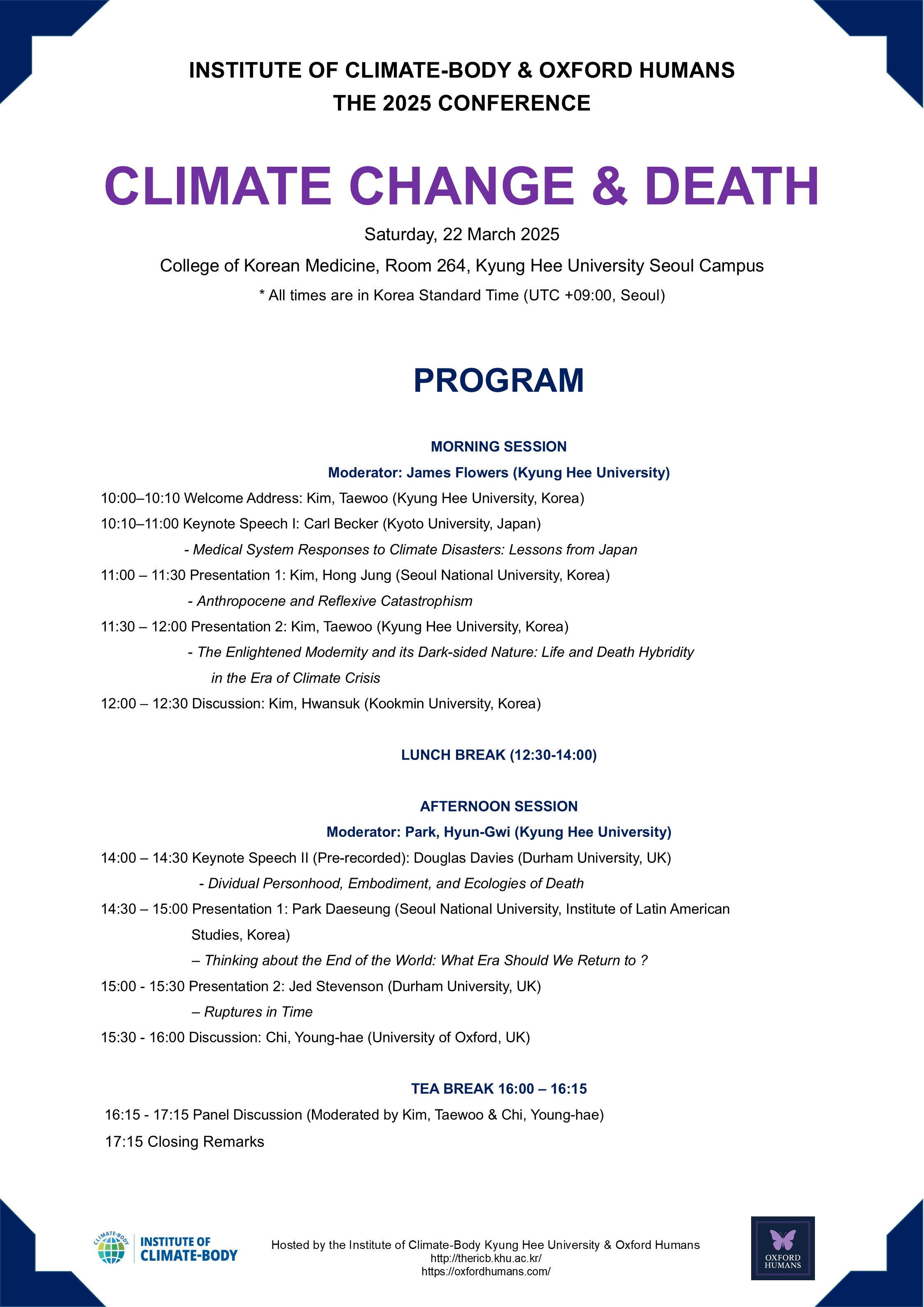
Institute of Climate-Body & Oxford Humans
The 2025 Conference
Climate Change and Death
Saturday, 22 March 2025
Oxford Humans and the Institute of Climate-Body of Kyung Hee University in Seoul has co-hosted a one-day conference to explore the impact of rapid climate change on collective human mortality and related issues. This event brougth together experts and scholars to discuss the challenges and future prospects of humanity in an era of environmental crisis.
Title: Climate Change and Death
Date: Saturday, March 22, 2025, 10:00 AM – 16:45 PM
Venue: Room # 264, College of Korean Medicine, Kyung Hee University Seoul Campus
Format: In-person and online hybrid
Zoom Link
https://us02web.zoom.us/j/2140714062?pwd=SG11aWpjaGtjNGRUeWNwTmdWaGhDdz09
Meeting ID: 214 071 4062
Passcode: 1008
YouTube Livestreaming
http://youtube.com/channel/UC7BqnQc0_KagngDSwDJvEng/live
Program
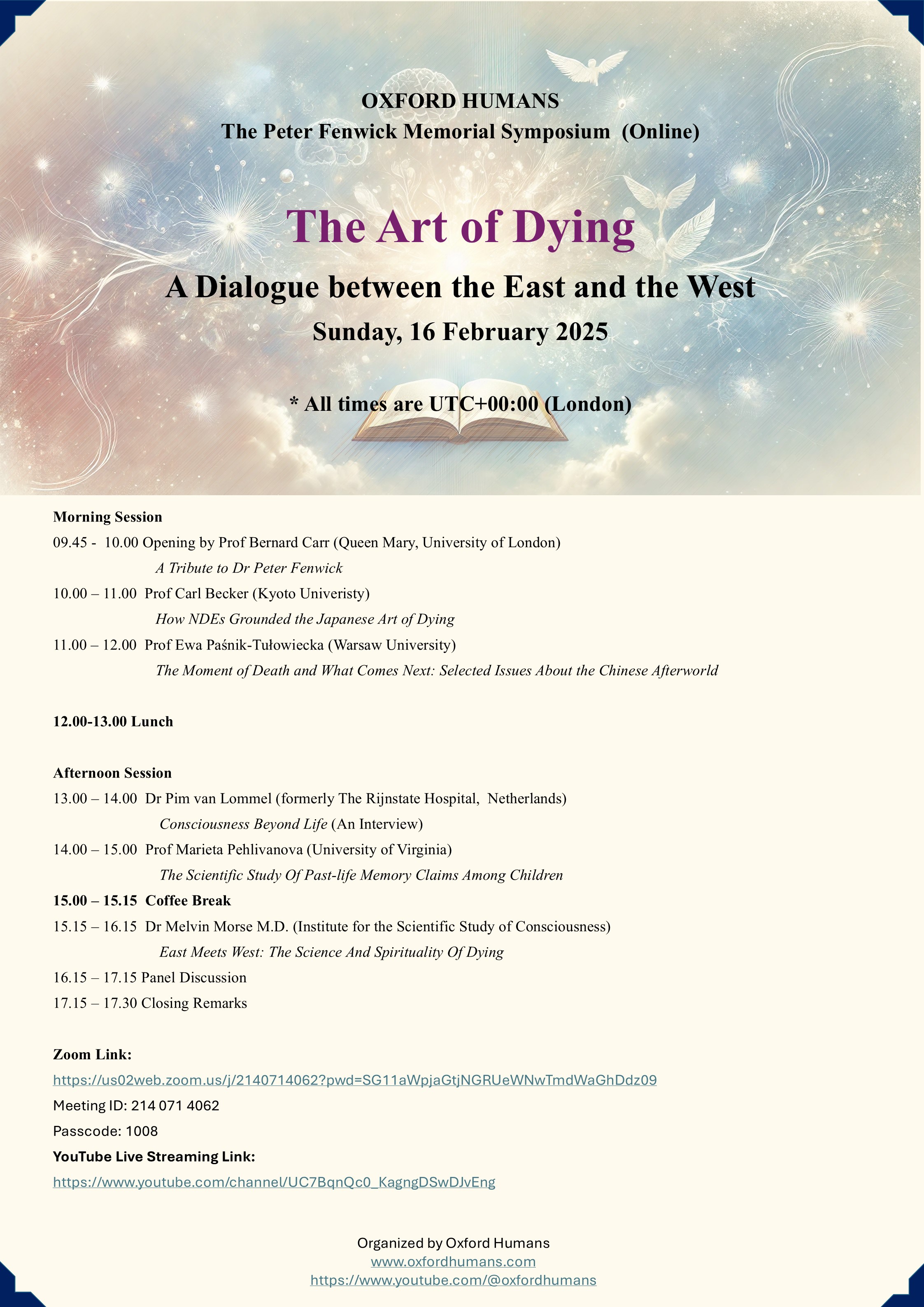
The Peter Fenwick Memorial Conference
The Art of Dying
Sunday, 16 February 2025
We held a one-day conference to honor the spirit and achievements of our recently deceased president, Peter Fenwick, and to deepen our understanding of the process and meaning of death. The details of the conference are as follows.
Title: The Art of Dying – A Dialogue Between East and West
Date & Time: 09:45-17:30, Sunday, 16 February 2025
Speakers:
Professor Bernard Carr
Professor Carl Becker
Professor Ewa Paśnik-Tułowiecka
Dr Pim van Lommel (Interview)
Professor Marieta Pehlivanova
Dr Melvin Morse
* The conference recordings will be uploaded on Oxford Humans YouTube Channel soon.
Program
Speakers

Professor Bernard Carr
Bernard Carr is Emeritus Professor of Mathematics and Astronomy at Queen Mary University of London. For his PhD he studied the first second of the universe with Stephen Hawking at Cambridge University and Caltech. He then held Research Fellowships at Trinity College and the Institute of Astronomy in Cambridge before moving to Queen Mary in 1985. He has also held Visiting Professorships at various institutes in America, Canada and Japan. His professional area of research is cosmology and astrophysics and includes such topics as the early universe, black holes, dark matter and the anthropic principle. He is the author of around 300 papersand the books Universe or Multiverse? and Quantum Black Holes. He is also very interested in the role of consciousness, regarding mind as a fundamental rather than incidental feature of the Universe. He has a long-standing interest in the relationship between science and religion and views psychical research as forming a bridge between them. He is President of the Scientific and Medical Network and a former President of the Society for Psychical Research.

Professor Carl Becker
Professor Carl Becker is currently a Specially Appointed Professor in the Policy Science Unit at School of Medicine at Kyoto University. He teaches medical ethics and policy, while leading a national survey on bereavement and psycho-social support for terminal patients, as well as for bereaved and suicidal survivors. He earned his PhD in Comparative East-West Philosophy from the University of Hawaii in 1981. Notably, he became the first American to achieve full tenure and promotion as a civil servant within Japan’s national university system.
In 1986, Professor Becker received the SIETAR Award for his contributions to cross-cultural understanding. More recently, in 2018, he was awarded an Honorary Doctorate in Psychology from the Graduate Institute of Psychoanalysis in Moscow for his work on counselling dying patients and bereaved clients. He also serves on the editorial boards of several respected journals, including Personalized Medicine Universe, Mortality, Journal of Near-Death Studies, and Journal for the Study of Spirituality. Though most of his work is written in Japanese, Professor Becker has recently edited and contributed to Spirituality as a Way: The Wisdom of Japan (Kyoto University Press) and authored the entry on “Spirituality” in the Encyclopaedia of Global Bioethics (edited by Henk Ten Have, Springer).

Professor Ewa Paśnik-Tułowiecka
Ewa Paśnik Tułowiecka, a graduate in sinology from University of Warsaw, since 2012 she has been an assistant professor in the Department of Sinology at the University of Warsaw. Her previous research interests have focused on death and dying in Chinese culture, the Chinese hereafter and early literary texts depicting them. More recently, she has been involved in research on the manuscripts of the Naxi people found in the Department of Oriental Studies, particularly in the context of the relationship between Naxi rituals and the Tibetan Bon religion. She is also interested in Chinese ethnobotany and ritual uses of plants in China.

Dr Pim van Lommel
Pim van Lommel, M.D., born in 1943, graduated in 1971 at the University of Utrecht, and finished his specialization in cardiology in 1976. He worked from 1977-2003 as a cardiologist in Hospital Rijnstate, a 800 beds Teaching Hospital in Arnhem, the Netherlands, and is now doing full-time research on the mind-brain relation. He published several articles on cardiology, but since he started his research on near-death experiences (NDE) in survivors of cardiac arrest in 1986 he is the author of over 20 articles, like the article in the Lancet in 2001, entitled ‘Near-death experience in survivors of cardiac arrest: a prospective study in the Netherlands’, one book and many chapters about NDE. He was co-founder of the Dutch IANDS in 1988. In 2005 he was granted with the Dr. Bruce Greyson Research Award of the International Association of Near-Death Studies (IANDS). In 2006, the President of India rewarded him the Life Time Achievement Award at the World Congress on Clinical and Preventive Cardiology in New Dehli.
His Dutch book ‘Endless Consciousness’ (in English ‘Consciousness beyond life’), was nominated for the ‘Book of the Year 2008’ in the Netherlands. It has now been translated into eleven languages, and worldwide more than 400.000 copies have been sold. In 2010 he received the 2010 Book Award van de Scientific and Medical Network, and in 2017 he received the Elisabeth Kübler-Ross Award by the Dutch Society of Volunteers in Palliative and Terminal Care (VPTZ). In 2020 the Spiritual Awakenings International (SAI) honored him for his ground-breaking work about Near-Death Experiences as Circle of Honor honoree. The Bigelow Institute for Consciousness Studies (BICS) started in 2021 an international essay contest for the best scientific evidence about the possible continuity of consciousness after death. With his article, entitled: ‘The Continuity of Consciousness’ he won the second Price.

Professor Marieta Pehlivanova
Marieta Pehlivanova, PhD is a Research Assistant Professor of Psychiatry and Neurobehavioral Sciences within the Division of Perceptual Studies at the University of Virginia School of Medicine. Marieta holds a PhD in Experimental and Cognitive Psychology from the University of Pennsylvania and a Bachelor’s degree in Statistics from American University. Her research at the University of Virginia primarily focuses on near-death experiences and children’s reports of purported past-life memories. She is interested in various aspects of these experiences, including cognitive, personality, and genetic factors contributing to their occurrence, veridical perceptions reported by experiencers, their impact on individuals, cross-cultural comparisons, and the development of support resources within healthcare settings for those who undergo such experiences.

Dr Melvin Morse
Dr. Morse graduated from Johns Hopkins University in Baltimore, Maryland, in 1975 with a Bachelor of Arts degree in Natural Science. He earned his medical degree from George Washington University in Washington, D.C., in 1980. He was voted one of the United States’ top pediatricians for five consecutive years. He published the first scientific study demonstrating that Reiki healers could alter the white blood cell count of neutropenic patients, a phenomenon that correlated with their ability to influence the electron flow of a true random number generator. He has also conducted several studies on spiritual healing, including research on the successful spiritual healing of tomato plants infected with the Tobacco Mosaic Virus.
Dr. Morse published a prospective study documenting that parents of infants who died from Sudden Infant Death Syndrome (SIDS) had genuine premonitions of their child’s death, as compared to control groups with healthy infants. He has authored numerous books, including Closer to the Light: Learning from the Near-Death Experiences of Children, Transformed by the Light, Parting Visions, and Where God Lives: Paranormal Science and How Our Brains Are Connected to the Universe—all of which were bestsellers in the United States. Dr. Morse has written extensively about spiritual experiences related to death and dying, including premonitions of death, shared dying experiences, and after-death communications. He has also appeared twice on The Oprah Winfrey Show and has been featured in numerous documentaries, including a series by Tom Harpur and another by the BBC.
2023
June

UK-Korea Death Forum III [with Korean translation]
The Venerable Beopsang, Korea
When: 12.00 pm BST London (8.00 pm Seoul, Korea) Thursday, 29 June 2023
Topic: What is death in Buddhism, and how to go beyond it?
Following the talks by two medical doctors in the previous UK-Korea Death Forums, this time we invited an influential spiritual teacher from the same country, The Venerable Beopsang.
The Venerable Beopsang became a Buddhist monk under the spiritual guidance of the Most Venerable Bulshim Domun. His search for truth was not limited to the teachings in the Buddhist circle. The Venerable Bosang took a spiritual journey that also covered a wide range of non-Buddhist traditions in scholarship and meditation practices while having dialogues with great masters in the East and the West. After a long spiritual quest, he finally settled in the teachings of the early Buddhist and meditation school, which came to form the backbone of his interpretation of Buddhist scriptures.
The Venerable Bopsang founded Temple Daewonjong in Sangju, Korea, as well as a number of local sanghas in Seoul and Busan in the same country. In those sanghas, he has been running a series of weekly talks where he invites not only lay Buddhists but also people of other religions and beliefs. In Daewonjong he includes in his teaching, for example, Tao Te Ching of Lau Tzu and modern philosophy both of the East and the West from comparative perspectives. He challenges his followers to see through to the unity of truth, in spite of the different names given to it in various religions and philosophies.
The lively talk was followed by questions and comments from the audience as usual. The Venerable concluded the final forum of this season’s series with the insightful observation that people are now waking up to who we truly are as the embodiment of Buddhahood everywhere in the West and the East.
Click here to watch the video.

UK-Japan Death Forum II
Professor Carl Becker, University of Kyoto, Japan
When: 12.00 pm BST London (8 pm Tokyo Japan), Saturday, 24 June 2023
Topic: Medical end-of-life and bereavement issues in Japan
After surveying Asian spiritualism on death and dying with special emphasis on Japanese Buddhism in Forum I, Prof Becker came back to the both audiences in the Trans-Atlantic and the Far East to discuss more practical and technical issues this time, Medical end-of-life and bereavement issues in Japan.
The talk was particularly interesting to those who wished to hear about comparative cultural perspectives on bereavement and grief as well as the way how the knowledge of the soul outliving the body could help both dying patients to overcome the fear of death and the doctors and nurses to ease burnout and the sense of defeat at the patients’ death.
Click here to watch the video.
April

Death Education at Schools
Mr John Adams, President NAFD UK
When: 5.00 pm BST London, Saturday, 15 April 2023
Topic: Why should we talk to school children about death?
For Mr John Adams, the President of National Association of Funeral Directors (NAFD) in the UK, the answer is a very strong Yes. Since he took over the Presidentship of the national organization in May 2022, Mr Adams has taken great efforts in promoting the inclusion of death education in the UK school curriculum. This required him to be involved in various social campaigns including media interviews and online petitions targeted at the UK Parliament. His efforts have recently led the Department for Education to announcing that it has decided to look at the matter in the next round consultation about the relevant curriculum contents.
During our forum, Mr Adams reported the background of his project and its progress together with the visions that we at Oxford have been sharing with him. Extensive discussions were made on various pros and cons about death education at schools including its potential impact on children in the rest of their life. During Q&A Mr Adams looked at some aspects of the funeral culture in the UK as an important background issue.
Click here to watch the video.

UK-Japan Death Forum I: On Asian perspectives on death and dying
Professor Carl Becker, University of Kyoto, Japan
When: 12.00 pm BST(British Summer Time, GMT+1) (8.00 pm Tokyo Japan), Saturday, 1 April 2023
Topic: Is there a Japanese way of well-dying?
Whereas our forum guests had been mostly with a Christian or scientific-medical background, Prof Becker differed. He has been deeply invested in Buddhism and Asian spirituality for his intellectual orientation, and as such he offers unique perspectives on one of the most interesting questions on death and dying: Will there be a Japanese way of well-dying?
Presently Prof. Becker is Specially Appointed Professor of the Policy Science Unit in the School of Medicine of Kyoto University, where he teaches medical ethics and policy, and leads a national survey on bereavement and psycho-social support for terminal patients and bereaved & suicidal survivors. He received his PhD in Comparative (East-West) Philosophy at the University of Hawaii in 1981. Subsequently he became the first American fully tenured and promoted as a civil servant within the Japanese national university system. In 1986 he received the SIETAR Award for Contributing to Cross-Cultural Understanding, and in 2018, an Honorary Doctorate in Psychology from the Graduate Institute of Psychoanalysis in Moscow for his work counselling dying patients and bereaved clients.
He serves on the editorial board of the Personalized Medicine Universe, Mortality, Journal of Near-Death Studies, Journal for the Study of Spirituality, and other medical journals. Most of his writings are in Japanese, but he has recently edited and contributed to Spirituality as a Way: The Wisdom of Japan (Kyoto University Press), and ‘Spirituality’ in the Encyclopedia of Global Bioethics (Ed. Henk Ten Have; Dordrecht, NL: Springer).
During the forum, Prof Becker looked at some crucial aspects of Japanese approaches to death and dying that he thought could inspire the West to reconsider the latter’s own practices. The survey of a broad cultural and religious understanding of death in Japan done in this forum is an integral part to the technical and practical approach to it that will be examined in the second part of Prof Becker’s talk. The second session will be at 12.00 pm BST (London), on Saturday, 17 June 2023.
Click here to watch the video.
March

Professor Soyoung Yoon, South Korea: A hematooncologist on cancer patients, death and afterlife
When: 12.00 pm GMT (London), Saturday, 11 March
Topic: Can cancer patients also die well?
Korean Translator: Mr Jinwoo Yu [Q&A session only]
For our March forum, we invited Professor Soyoung Yoon, MD, PhD in South Korea and heard her experiences with her patients and what she thought of death and afterlife.
Prof Yoon is currently working as a specialist in the Department of Hematooncology at the Medical School, Konkuk University in Seoul. Since 2004 she has been conducting chemotherapy, palliative care, and hospice care at the Medical Centre. Prof Yoon actively supports patients’ rights to dying with dignity through VSED (voluntarily stopping of eating and drinking).
In our talk she explained how the witnessing of consciousness communications by dying patients and their death-bed experiences had led her to believing in the survival of consciousness after death. Now the supporting evidences have been incorporated in her teaching curriculum at the Medical School. After over 20 years of dealing with cancer, she now believes that the patients can die with dignity with a plenty of time to prepare for their death.
Click here to watch the video.
February

Dr Pim van Lommel on Near-death Experiences
When: 5.00 pm GMT (London), Saturday, 25 February
Topic: What does the scientific research in survivors of cardiac arrest tell us about the mind-body relationship?
Whereas Prof Keith Ward presented a philosopher’s case for the eternity of consciousness in the previous forum, Dr Pim van Lommel, M.D. from the Netherlands, made the exactly same proposition but from a medical point of view. The cases of cardiac arrests that he had studied for the last 40 years convinced him that consciousness is indivisible and endless. Therefore to say that we survive death is a misstatement; rather, from the start death was not and never will be.
Dr van Lommel worked between 1977-2003 as a cardiologist at Hospital Rijnstate in Arnhem, the Netherlands, and is now doing full-time research on the mind-brain relationship. He published several articles on cardiology, but since he started investigating the survivors of cardiac arrest in 1986 that eventually led to the publication of the acclaimed article on NDEs in The Lancet in 2001, he is now the author of a book and 20 plus articles (most of them in Dutch) as well as a number of chapters about NDEs. In November 2007 his book Eindeloos Bewustzijn (Endless Consciousness) was published in the Netherlands, and it was translated in English by Harper Collins in 2010, entitled Consciousness beyond Life: The science of the near-death Experience. He strongly suggested that the audience read this book as a backup of his forum presentation.
Click here to watch the video.

Professor Keith Ward on the Problem of Self, Death and Eternity
When: 5.00 pm GMT (London), Friday, 3 February
Topic: Do we exist after physical death? And what does it mean for our life here and now?
Prof Ward was ordained as a priest in the Church of England in 1972, and was Regius Professor of Divinity at the University of Oxford from 1991 until he retired in 2004. In 1993–94, he delivered the prestigious Gifford Lectures at the University of Glasgow. Since he retired from teaching positions, he has been actively writing and widely lecturing about his core belief as an Idealist philosopher.
Prof Ward explained how his own belief that the material universe is an expression or creation of a Supreme Mind led to the discovery of fundamental spiritual truth as to the nature of death, while at the same time being guided to a learned interpretation of how ancient religious beliefs and the modern scientific world view have been in a constructive dialogue in search of the answer to the crucial questions of death and immortality.
Click here to watch the video.
January

The US-Asia Death Forum: Dr James G. Matlock on Reincarnation [with Korean translation]
12.15 pm GMT (London), Saturday, 7 January
Topic Reincarnation: Beliefs and Research
Dr Matlock, an anthropologist from Southern Illinois University and a research fellow at Parapsychology Foundation in the US, has been evaluating various evidence of reincarnation including the claims of past life memories by young children for many decades. The results have been published in two recent books, I Saw A Light And Came Here: Children’s Experiences of Reincarnation (with Erlendur Haraldsson) (2017) and Signs of Reincarnation: Exploring Beliefs, Cases, and Theory (2019). For further information about Dr Matlock, visit his personal website. In our forum Dr Matlock engaged with the audience in the Far East to show how his research had confirmed some of the traditional beliefs of reincarnation in Buddhism and Hinduism but not some others. In addition he has explained some peculiar phenomena related to reincarnation, such as birth with bodily marks and scars, from modern scientific perspectives.
Click here to watch the video.
2022
December


Dr Peter Fenwick & Rev Lord Rowan Williams: A Colloquium
When: 5 pm GMT, Monday 12 December 2022
Title: What is death, and How to Die Well
Dr Fenwick, the President of Oxford Humans, came back to the forum, but this time teamed up with The Lord Williams of Oyster, the 104th Archbishop of Canterbury, to explore What is Death and How to Die Well. Dr Young-hae Chi, the moderator, started the conversation with the question, Do we continue to exist after physical death, and if so, where does the soul journey through and towards what?
The two speakers were actively engaged in a conversation on some of the most crucial questions in relation with death including, Do heaven and hell exist?; Can we talk about death and the journey of our soul without assuming the existence of God?; Is there reincarnation?; What things are wrong with the present funeral culture and burial practices?; Is death education for children at primary and secondary schools desirable?; What should we do about the rising anxiety of death among youngsters particularly in relation to climate change?; and, How can we best meet our personal death?
The talk was followed by a number of questions from the audience, of which the issue of reincarnation stood out. At the end of the session, Dr Fenwick and Rev Lord Williams sent out their blessings to the audience and those who would be coming across their talk by setting up a candlelight blessing ceremony and saying a prayer respectively. The whole event was a beautiful blend not only of scientific empiricism and Christian spirituality but also of knowledge and love.
Click here to watch the colloquium video.
[Summary of the colloquium]
In this discussion, Dr. Rowan Williams (a theologian and the 104th Archbishop of Canterbury) and Dr. Peter Fenwick (a neuroscientist and psychiatrist) both agree that death is more than mere biological cessation: it marks a significant transition or transformation in our consciousness and identity. They concur that fear of death stems largely from cultural avoidance and can be eased through open conversations, spiritual or contemplative practices, and acceptance of our mortality. Both stress that preparing for death is crucial—whether through prayer, meditation, or learning to “let go” of attachments—so one may approach dying with greater serenity and clarity.
They also share the view that genuinely facing death can deepen one’s capacity to live well in the present, encourage more truthful relationships, and enrich one’s sense of love and community. Both advocate “death education” for younger generations, noting that children naturally encounter questions about mortality (e.g., through pets) and can benefit from honest guidance rather than denial.
Where they differ is in their degree of certainty regarding the specific nature of post-mortem existence. Dr. Fenwick presents evidence from near-death experiences and cases suggestive of reincarnation, asserting that consciousness likely continues beyond the body. Dr. Williams is more cautious about reincarnation, noting that traditional Christian theology has emphasized a direct “homecoming” to God (rather than repeated rebirth). Yet he remains open to learning from such research and emphasizes the Christian conviction that “who we become” matters profoundly—our journey continues in relation to the infinite love of God.
Despite these nuances, both ultimately agree that cultivating love, release from ego, and preparation are key aspects of dying well and living meaningfully before death.
November
Dr Peter Fenwick: An Interview
When: 5 pm GMT, Friday 11 November 2022
Title: End-of-life experiences: What do they teach us about death and life after death?
Dr Young-hae Chi interviewed Dr Peter Fenwick, formerly a Senior Lecturer at the University of London, on various issues related to end-of-life experiences. A renowned neuroscientist and psychiatrist, Dr Fenwick talked about what would happen and what we would see just before we die, and explained what those experiences tell us about the fate of our soul and what we need to do before we leave our body. Dr Fenwick also talked about his visit to see Dalai Lama that happened a few weeks prior to this forum. He introduced what His Holiness told him about the same issues in detail.
Click here to watch the video.
October

Dr Young-hae Chi: The School Talk at Harrow
When: 5 pm (GMT), Tuesday, 11 October 2022
Where: Harrow School, Harrow, United Kingdom
Topic: How to Think Big, The Oriental Understanding of Death and the Modern Response of the West
Dr Young-hae Chi, currently our Director, was honoured to be invited by the Oriental Society of Harrow School in London for a public lecturer. The talk lasted for 90 minutes with lots of interesting questions from the students, including the veracity of children’s memory of their own previous life. The lecture was followed by a dinner with the Society’s student representatives in the specially decorated guests’ dining hall that displayed the unique hats of the School’s 12 houses.


The UK-Korea Death Forum: Dr Peter Fenwick and Professor Hyun Chae Jung [with Korean translation]
8 October 2022
Forum subject: What is death, and how to die well?
The forum was the first kind that happened between the UK and Korea as a way of implementing one of the Oxford Humans’ founding visions, brining the West and the East together. The forum participants were honoured to have two distinguished researchers from the UK and South Korea.
Dr Fenwick, formerly a Senior Lecturer at the University of London and the President of Scientific and Medical Network, is a world authority on end-of-life experiences such as death-bed vision and death communication as well as NDEs and reincarnation. He co-authored many books on the subjects with his wife, Elisabeth Fenwick, including The Art of Dying (2008). The book was translated in Korean in the same year. An Emeritus Professor at the College of Medicine, Seoul National University, Dr Jung has studied numerous cases of patients’ end-of-life experiences. He wrote a best-seller in Korea entitled Why There is No Need to Be Afraid of Death (2018) in Korean.
The forum was joined by two discussants, Professor So-young Yoon, an oncologist at the Medical School of Konkuk University, and Young-hwan Lee, an Emeritus Professor in Economics at Dongguk Unviersity in Seoul. Prof Yoon and Prof Lee added their own experiences and interpretations to the cases discussed by the two speakers. The online event was concluded with Dr Fenwick’s suggestion that the audience use an app called WeCroak that would remind them five times a day that they would die. The audience responded to it with enthusiastic applause.
Click here to watch the video.